










The Science of Synthetic Genomics
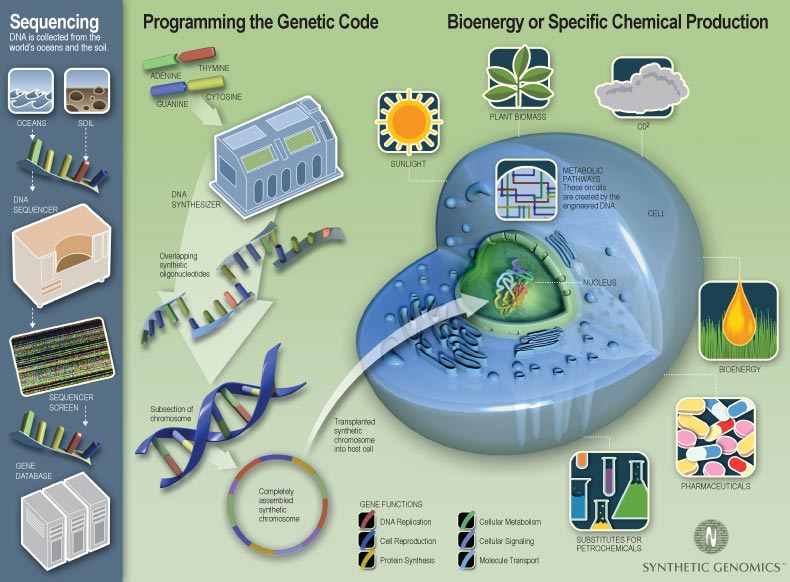 In the last two decades the field of genomics has undergone a revolution. Scientific discoveries have come at a dazzling pace. These breakthroughs were made possible by advances in underlying enabling technologies such as high-throughput DNA sequencing, high-performance computing and bioinformatics. Many of these advances are directly attributable to the innovation of Dr. Venter and his teams. With the genomes of more than 300 organisms and millions of newly discovered genes readily available, genes now have the potential to be the design components of the future industrial world.
Synthetic Genomics
Genomics has improved our understanding of the workings of living organisms through sequencing and analyzing DNA; Synthetic Genomics is focused on the next powerful step of synthesizing and programming DNA by developing and utilizing the latest advances in synthetic genomics. Synthetic genomics is a new field of science that involves the design and assembly of genes and gene pathways and whole chromosomes from chemical components of DNA. As a computer analogy, we view the genome of a cell as the operating system and the cytoplasm of the cell as the hardware. The cytoplasm contains the ribosomes and the other components necessary for expression of genetic information contained in the genome. Synthetic Genomics’ goal is to modify the cell’s operating system, design new genomes, to code for new types of cells with desired properties for the production of bioenergy or substitutes for petrochemicals.
We seek to lead the world in the ability to design, synthesize and assemble specifically engineered cell level bio-factories. Using the genome as a bio-factory, a custom designed, modular “cassette” system will be developed to serve as a platform for biologically-based software. The ability to make extensive changes to the DNA of a chromosome, assemble it and insert it into an organism is in its infancy, and the capability to assemble chromosome length strands of DNA will be integral to the success of the company. Synthetically produced organisms with reduced or reoriented metabolic needs will enable new, powerful and more direct methods of bio-engineered industrial production. We believe that a synthetic chromosome, and eventually a synthetic cell, will become an integral tool for the energy, chemical and pharmaceutical industries.
Ethical Considerations with Emerging Technologies
Synthetic genomics holds great promise for addressing energy, environmental and human health challenges, but as with many areas of science it is important to address and understand any potential for misuse. Dr. Venter and his teams have been working to help drive this field scientifically while also focusing on the ethical and societal implications of this work. He has been leading and supporting serious review of dual-use technologies by various scientific and governmental organizations to ensure there are adequate safeguards for any research having the potential for misuse. In the late 1990’s Dr. Venter and colleagues sought out an outside year long ethical review of their work on the minimal genome. Recently, a policy team at the J. Craig Venter Institute, along with collaborators from the Center for Strategic & International Studies, and the Massachusetts Institute of Technology, convened a series of workshops to explore the risks and benefits of synthetic genomics. A report will be issued in summer 2007 which will provide guidelines on laboratory standards in synthetic biology. We believe the investment in basic science research and the advancement in cutting-edge fields of basic biological research are the most effective ways to ensure that there are adequate protections against potential biothreats.
Cellular Engineering
Synthetic Genomics’ metabolic engineering team is applying the latest advances in synthetic genomics to the design and development of microbes for industrial processes and environmental applications. Synthetic Genomics is harnessing natural genetic diversity of microbes to optimize useful metabolic pathways and to make them more efficient on an industrial scale. Applications of metabolic engineering include the conversion of sunlight and carbon dioxide or plant biomass into renewable bioenergy sources.
Metagenomics
Greater than 99% of Earth’s genetic and metabolic diversity resides in the microbial universe of bacteria, fungi, archaea, protozoa and microalgae. These microbial communities affect the structure and function of ecosystems, regulate the cycling of carbon, nitrogen, and other nutrients throughout the environment and sustain all life on Earth. We believe the natural diversity of microorganisms hold some of the keys to clean energy solutions addressing some of our most vexing environmental challenges.
Synthetic Genomics’ metagenomics team is exploring the vast untapped world of microorganisms from diverse environments by discovering novel genes and pathways residing in the genomes of environmental microorganisms. The emerging field of metagenomics enables scientists to study, with great precision, the uncharacterized microbial communities populating virtually every niche of the biosphere. These genomic-driven molecular tools are providing new ways to evaluate microbial metabolism, ecology, evolution, biochemistry, physiology and biodiversity. Moreover, by leveraging the genes and pathways discovered via metagenomic studies, biotechnologists can apply these synthetic genomics tools to engineer optimal microorganisms for a variety of bioenergy applications.
Microbial Cultivation
Microorganisms are the most abundant source of life on the planet and represent the greatest genetic diversity reservoir. Microbial communities play important roles in energy and matter bioconversions in all ecosystems and their activities have an important impact at global scale. It is estimated that less than one percent of the microbial biodiversity has been cultivated in the laboratory. To gain access to novel uncultured microorganisms, Synthetic Genomics is developing innovative microbial cultivation technologies and monitoring approaches that will reveal novel microorganisms, suites of new genes and robust fermentation platforms for metabolic engineering of microbes for commercial bioenergy applications. Synthetic Genomics’ microbiology team is combining optimized cultivation techniques for diverse microorganisms with proprietary methods developed specifically for the isolation of strains exhibiting desired traits such as enhanced bioenergy production.
Tools of Genomics
DNA Sequencing
Whole-genome and metagenome sequencing is utilized to help characterize microbial communities. Efficient DNA sequencing is a complex process that requires meticulous preparation and organization as well as cutting-edge equipment, from template robots to high-throughput sequencing machines. Synthetic Genomics supports sequencing at the J. Craig Venter Institute’s Joint Technology Center, one of the world’s leading DNA sequencing organizations. With 100 of the newest and most advanced sequencing machines at its 60,000 square-foot facility, the JTC currently produces 40 million sequence reads per year with the potential capacity to increase to more than 120 million lanes per year. The center has sequenced the genomes of more than 100 organisms since the first genome of a free-living organism was sequenced in 1995.
Genome Sequence Analysis
Synthetic Genomics is employing a suite of novel and public domain computational tools to help identify and annotate genes, assemble sequences and compare closely related genomes. The company applies an interdisciplinary team approach incorporating the expertise of mathematicians and biologists to tackle different aspects of the most challenging issues related to computational biology. The bioinformatics team collects, classifies, stores and analyzes all that can be harnessed to produce clean and renewable energy.